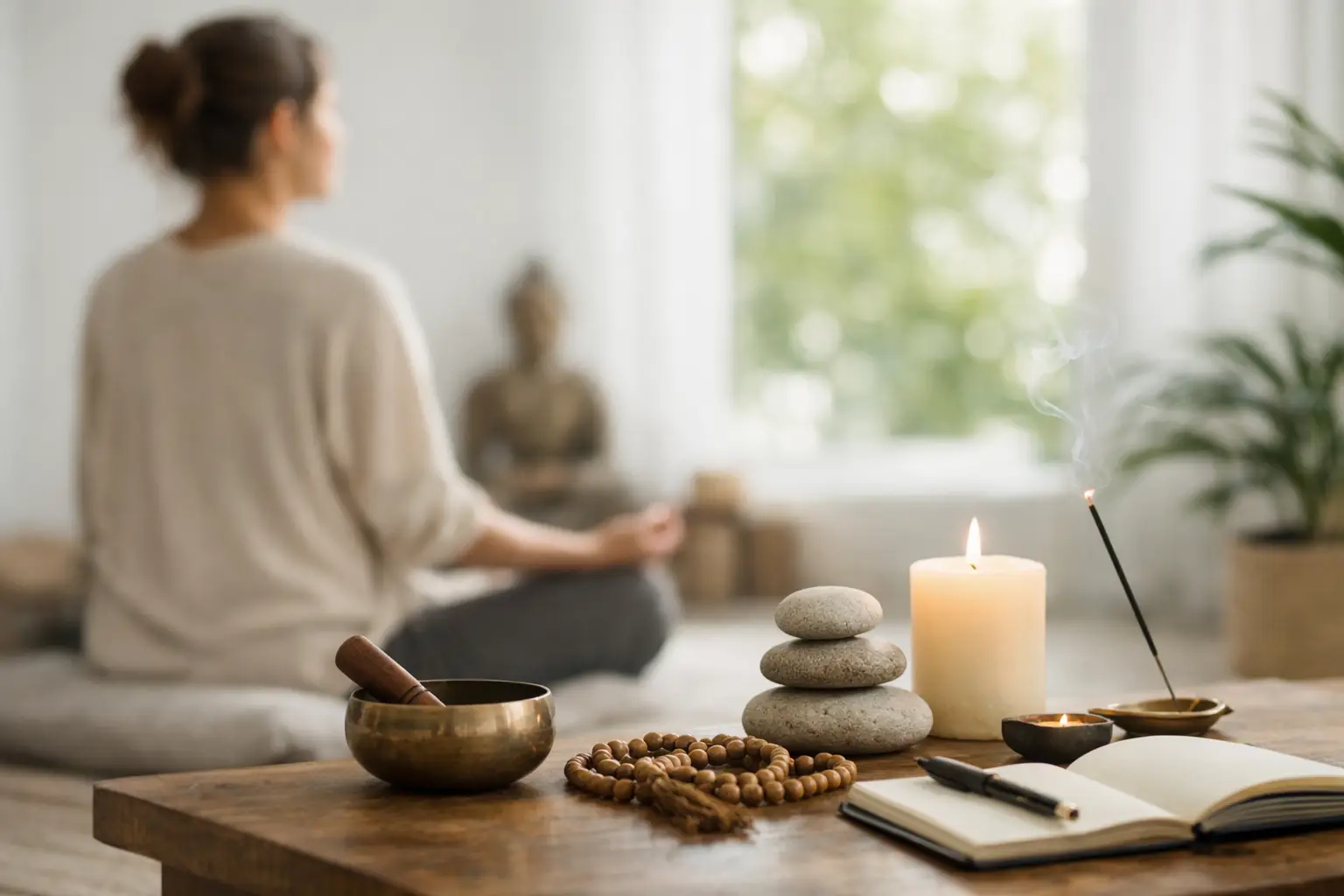
Your alarm goes off, your mind starts listing what needs to be handled, and before your feet touch the floor, your energy belongs to everyone else. A daily spiritual practice routine creates a different beginning. It gives you a moment to come home to yourself before the messages, deadlines, opinions, and old patterns begin asking for your attention.
This is not about performing spirituality perfectly or adding another demanding task to a full life. It is about making one conscious choice, then another, until your inner world begins to feel like a place you can trust. Awareness is the first step to ascension, and a simple daily rhythm can help you meet your life with more clarity, calm, and personal power.
What a Daily Spiritual Practice Routine Is Really For
A spiritual routine is not a checklist designed to prove that you are healed, positive, or connected. It is a relationship with your own energy. Some days that relationship may look like a ten-minute meditation. Other days, it may be a hand on your heart and an honest admission that you are overwhelmed.
The purpose is to create space between what happens around you and how you choose to respond. When you practice consistently, you may begin to recognize the difference between fear and intuition, urgency and alignment, an old wound and a present-moment truth.
Your routine can also support emotional healing. Feelings that are ignored tend to find other ways to speak through irritation, exhaustion, overthinking, or disconnection. A few intentional minutes each day give those feelings a safe place to move, soften, and reveal what they need.
There is no universal formula. If silent meditation makes you feel more anxious, choose breathwork, gentle movement, journaling, or calming music instead. If you are naturally intuitive, an oracle card pull may help you reflect. If you prefer structure, a repeated prayer or guided practice can become a steady anchor. The right practice is the one you can return to with honesty.
Start Small Enough to Keep Your Promise
The most powerful routine is not the longest one. It is the one that survives real life.
Many people begin with a beautiful vision of an hour-long morning ritual, then abandon it after three busy days. That does not mean they lack discipline. It often means the practice was built for an ideal schedule rather than the life they actually live.
Start with ten minutes. Choose a time that already has a natural place in your day, such as before coffee, after a shower, during a lunch break, or before sleep. Attach the practice to a habit you already keep. Your nervous system learns through repetition, and consistency builds trust more effectively than intensity.
Create a small physical cue as well. It could be a candle, a journal on your nightstand, headphones by your favorite chair, or a designated corner where you sit for a few quiet breaths. The space does not have to look sacred to anyone else. It simply needs to remind you that this is your time to listen inward.
A Simple Daily Spiritual Practice Routine
A balanced practice has three qualities: it brings you into the present, helps you hear yourself clearly, and directs your energy toward the reality you want to create. The following sequence can take ten to twenty minutes, depending on how much space you have.
1. Arrive in your body
Begin before you reach for your phone. Sit comfortably, place both feet on the floor or lie down, and take several slower breaths. Notice the weight of your body, the temperature of the room, and any places where you are holding tension.
As you exhale, imagine releasing what is not yours to carry. You do not need to force your mind to become blank. Thoughts may still appear. Let them pass through without turning each one into a problem to solve.
If it feels supportive, say: I return my energy to myself. I release what is not mine. I am safe in this moment.
2. Check in without judgment
Ask yourself, What am I feeling right now? Then ask, What do I need most today?
The answer may be rest, courage, patience, a boundary, a difficult conversation, or simply more water and less pressure. Do not rush to make the answer spiritual enough. Your soul can speak through ordinary needs, too.
Journaling for a few minutes is especially helpful here. Write without editing. Let the page hold the thoughts you have been carrying in circles. Over time, you may notice repeated themes that point toward a belief, relationship dynamic, or desire ready for your attention.
3. Choose an energetic intention
An intention is not a demand that the day go your way. It is a decision about how you want to meet the day.
Choose one clear statement that feels believable and alive in your body. You might say, I choose peace over proving myself. I allow myself to receive support. I trust myself to take the next right step. I am available for a new choice, a new reality, and a new future.
Keep it specific if you are moving through something challenging. Before a meeting, your intention may be to speak clearly without abandoning yourself. During a season of grief, it may be to let your heart be tender without making your pain your identity.
4. Open a channel for guidance
This is the part of the practice where you listen beyond the loudest thoughts. You may sit in meditation, pull an oracle card, read a meaningful passage, work with a guided visualization, or simply ask a question and wait quietly.
Try asking, What wants my attention today? What am I ready to see differently? Where can I bring more compassion?
Guidance is not always dramatic. It may arrive as a gentle sense of relief, a memory, a phrase that stays with you, or a clear realization that you need to slow down. Treat intuitive messages with both openness and discernment. A grounded spiritual practice supports your agency. It does not ask you to surrender your judgment, ignore practical realities, or make major decisions from a single emotional moment.
5. Close with one embodied action
Before you finish, choose one action that honors what you heard. Send the message you have been avoiding. Take a walk without your phone. Decline an invitation that drains you. Put a nourishing meal on your calendar. Spend five minutes researching the next step toward a goal.
Spiritual insight becomes transformative when it enters your behavior. Your practice is not separate from your life. It is preparation for living it with more intention.
Morning or Evening: Which Works Best?
Morning practices are powerful because they help you set your energy before the outside world shapes it. If you tend to wake up scattered, worried, or reactive, even a brief morning ritual can change the emotional tone of your day.
Evening practices offer something different. They help you release what you absorbed, reflect on what the day taught you, and rest without carrying every unfinished thought into sleep. This can be especially supportive for people who feel other people’s emotions deeply or spend their days in high-demand environments.
It depends on your life and your nervous system. You may prefer a three-minute morning intention and a longer evening release. You may also need a midday reset on difficult days. Think of your routine as a living support system, not a rigid rule.
When You Miss a Day
Missing a practice does not mean you have failed or lost your connection. Spiritual growth is not measured by a perfect streak. It is measured by your willingness to return.
When you notice you have drifted, resist the urge to shame yourself into restarting. Instead, begin again with the smallest possible act: one breath, one sentence in your journal, one moment with your hand over your heart. That return is the practice.
If you keep avoiding your routine, get curious. Perhaps it has become too complicated, too emotionally intense, or disconnected from what you actually need. Simplify it. Let it serve you where you are, not where you think you should be.
Let Your Practice Evolve With You
The routine that supports you during a busy career season may not be the one you need while healing from loss, stepping into a new relationship, or deepening your intuitive gifts. Give yourself permission to change the tools while keeping the commitment.
Some seasons call for quiet. Others call for movement, music, community, professional guidance, or deeper one-on-one spiritual support. Open Up Wide exists for those moments when you want practices and insight that meet you beyond the surface, while still fitting into the rhythm of everyday life.
You do not have to wait for a crisis to choose yourself. Tomorrow, before the world asks you to become everything for everyone else, take a few minutes to listen. Your inner wisdom has been there all along, patiently waiting for the space to speak.